
FAQs
HPOA Frequently Asked Questions
Governance
What will the governance structure for CHCPBC look like under the HPOA?
CHCPBC will continue to have a Board and committees that consist of equal numbers of both non-licensee public members and licensees, however, all positions on the Board will be filled by appointment. CHCPBC is currently compliant with the requirements for a competency-based Board under the HPOA.
The Health Professions and Occupations Regulatory Oversight Office will be responsible for recruiting and recommending, both licensee and non-licensee candidates, to the Minister of Health for appointment to the Board. The HPOA has removed the process of elections of licensees to the Board.
Board members have a fiduciary duty to the College and the public.
How is profession-specific knowledge embedded in the College’s governance structure?
CHCPBC retains profession-specific expertise through staff and committee members who are licensed to practice the professions we regulate. These health professionals provide relevant and timely information on current practice contexts to help inform decisions that will impact professions.
We have a full complement of Practice Advisors on staff who receive enquiries from licensees and provide support to help them understand regulatory obligations. We also have the Professional Practice Standards Advisory Committee, which includes licensees from each profession CHCPBC regulates. Individuals on this committee provide advice, feedback, and recommendations to the College to support profession-specific decision-making.
Additionally, our current statutory committees, including the Registration Committee and Inquiry Committee, are large and include members from each of the professions CHCPBC regulates. Our current Bylaws require a panel composition of at least two individuals from the designated profession, and at least one from the public member to form a panel to make decisions. This model will continue under the HPOA and is reflected in the draft bylaws.
Why will there be no elections of health professionals to the Board when the HPOA is in force?
The HPOA requires that all Board members are appointed by the Minister of Health through a competency-based process for both public and licensee Board members. The CHCPBC draft bylaws must comply with this requirement.
The Board will continue to consist of public and licensee Board members. The College will collaborate with the Superintendent who is responsible for managing this process and making board appointment recommendations to the Minister of Health. For more information on how boards will be appointed, please review the Ministry’s HPOA Q&A (PDF) on this topic.
When will we know who is on the new Board?
Members of the new Board will be updated in the Board section of our website by April 1, 2026.
Why aren’t all professions able to be represented on the Board?
The HPOA allows regulatory colleges to have a Board of eight to 12 Board members, 50% of which must be health professionals. This means that up to six Board members can be health professionals. Because CHCPBC currently regulates nine professions, and in 2027 will regulate 10 professions, it is not possible for each profession to always sit on the Board.
More importantly, boards of regulatory colleges do not serve to represent their professions, rather, their role is to govern and oversee the direction of the College. CHCPBC’s Board is currently and will continue to be a competency-based board that is focused on, strategy and fiduciary duty. Profession specific matters will continue to involve professionals at the staff and committee levels under the HPOA.
What committees are required under the HPOA?
The HPOA requires the following committees with decision-making authority:
- Investigation Committee
- Licence Committee
- Permit Committee (Health profession corporation permits)
Other committees may be formed at the discretion of the Board.
Where can I find the College’s governance policies?
CHCPBC’s governance policies are published in the Board and Committees sections on our website.
Bylaws
What is the status of consultations on the new HPOA bylaws?
Following more than five months of public consultation on individual draft bylaw parts, the complete CHCPBC draft bylaws under the HPOA were posted December 9, 2025 on the HPOA Bylaws Consultation page for a final opportunity for feedback. Consultation on the complete draft bylaws closed January 15, 2026. After considering and incorporating any applicable feedback from this consultation, the draft bylaws will be presented to the Board for approval and become effective on April 1, 2026.
Bylaw consultations with Indigenous governing bodies as required in the HPOA are being conducted by an external Indigenous consultant on behalf of all health regulatory colleges.
Why are there a lot of details missing in the bylaws?
CHCPBC’s approach to the draft HPOA bylaws was to include the essential requirements and to use policies to include more detailed information.
How was consultation feedback on the draft bylaw parts considered?
During the initial consultation, the College received a total of 1,1,84 feedback submissions. All submissions were reviewed and put into one of the following categories:
- Actionable: change necessary, revisions made.
- Potentially actionable: further discussed and assessed by College staff, leadership, and legal to determine if change is needed and advisable.
- Not actionable: no change but informed communication of other documents that will be developed later (policies, guidelines, resources).
Several revisions were made to the draft bylaws to improve legibility and to further clarify the intent of each part. Some content was also moved from one section to another for the same purpose. Lastly, some more significant changes were made based on feedback received and are described below.
Are professions with fewer registrants disadvantaged by the new CHCPBC bylaws?
No, professions regulated by CHCPBC will not be disadvantaged by the new CHCPBC Bylaws. After amalgamation, CHCPBC has prioritized the need for harmonized programs, policies, and procedures that are equitable for the health professions we regulate. This work has continued and has influenced the development of HPOA bylaws for CHCPBC.
We also acknowledge the need for profession-specific expertise at multiple levels in the organization that will continue under the HPOA. This includes:
- Committees will continue to work in panels with at least 2 members of the profession when a decision concerns profession-specific expertise.
- The Professional Practice Standards Advisory Committee includes members of all professions.
- The College employs staff from each health profession we regulate to provide their expertise and knowledge into our regulatory work.
- Under the HPOA, the Board is required to consult with Professional Standards Advisors before making a decision on eligibility standards, ethics standards, and practice standards. These advisors must be licensees of the designated health profession to which the standards relate when they provide advice or recommendations.
Licensure
Why is the term “registrant” changing to “licensee”?
When the HPOA takes effect on April 1, 2026, it will introduce new terminology. Most notably, health professionals regulated by a college will be called “licensees” instead of “registrants.” CHCPBC will continue to regulate all of its current professions under the new HPOA framework. As we prepare for this transition, you may notice that these terms change in our communications and on our website in the weeks leading up to April 1.
Why will applicants be required to have a course on cultural safety and humility when many educational programs already include this training as part of their curriculum?
Section 14 and 15 of the Health Professions and Occupations Act make anti-discrimination and Indigenous-specific anti-racism part of the mandate of health regulatory colleges. In order to support these objectives, new applicants will be required to complete a course on cultural safety and humility, including Indigenous-specific and other anti-racism approaches, in the form and manner ordered by the registrar.
Components of approved educational programs completed by applicants may qualify to meet this requirement. However, eligible courses will need to consider the BC context and align with recommendations in the In Plain Sight report and requirements within the Declaration on the Rights of Indigenous Peoples Act. Many health professionals are trained outside of the province through programs that are less likely to have this specific training.
It is not anticipated that these requirements will be in place on April 1, 2026 when the HPOA comes into force. More information on the requirements for new applicants will be provided on the website when it is available.
It is important to remember that providing culturally safe and appropriate care goes beyond cultural awareness or sensitivity that can be learned in a single course. It’s a lifelong commitment to critical self-reflection, ongoing education, and the continuous examination of power dynamics that have historically marginalized Indigenous peoples within healthcare and social service systems.
Why is the non-practising registration category being removed? How can registrants manage short periods where they may not be practising due to a leave (i.e., sick leave, parental leave)?
The non-practising registration category will be removed in the new set of HPOA bylaws because it does not provide added benefit to the public or licensees in terms of reinstatement or relief of registration and application fees.
Approximately 400 of the almost 17,000 registrants are registered as non-practising. As there are no clear advantages for the public and licensees, the College made the decision to harmonize the licensure classes and remove this particular class.
Currently, the process and costs to reinstate your registration from a non-practising registration status or as a former registrant with the College are the same. The fee restructuring project that will be shared with registrants later this fall will also provide some efficiencies for those who wish to reinstate their registration under the HPOA.
Licensees (registrants) have the option to maintain their full registration during short absences from practice. If they anticipate being away from practice for a longer period they may choose to cancel their license and apply for reinstatement when they are ready to return. The College is proposing a streamlined reinstatement process for those professionals who were full licensees of the College within the past 3 years.
Under the HPOA, will the College require proof of vaccination?
The College has no intention to establish proof of vaccination as a licensure requirement for new applicants entering the profession.
The HPOA largely dictates the bylaw requirements regarding the possibility of mandatory vaccinations. For licensing purposes, s. 49(1)(b)(v) of the HPOA requires college boards to make bylaws respecting eligibility standards for “mandatory vaccinations, required under an enactment other than the bylaws, against transmissible diseases”. As a consequence, college boards are required to include such eligibility standards in their bylaws.
While the HPOA also authorizes college boards to make bylaws respecting “mandatory vaccinations, required under the bylaws, against transmissible illnesses”, the College considers this authorization would only be engaged in exceptional circumstances where, for example, colleges are mandated by other provincial government agencies to “enforce” vaccination requirements (such as those that may be imposed by the Provincial Health Officer under the Emergency and Disaster Management Act). The College does not anticipate using this power within its bylaws except when following a directive or order of the Provincial Health Officer or other government agency in the event of a health emergency.
Why do documents required for initial application and reinstatement, such as certificates of professional conduct, need to be dated within 60 days of the registration application to the College?
The 60-day rule for documents reduces the risk to the public by ensuring we have accurate, up-to-date information when reviewing applications. This time limit will be applied to all professions and helps us process applications more efficiently without delays from outdated documentation. The 60-day window gives applicants time to gather what they need while ensuring we make decisions based on current, reliable information.
Complaints & discipline
Will the process for filing a complaint be different under the HPOA?
No, if you have a concern about the conduct or competence of a licensee of CHCPBC, you may submit a complaint to the College by completing the online Complaint Form, by sending us an email, or by mailing in your complaint. If you need help making a complaint, you can email or call the College and an intake officer will assist you.
Will the investigation and resolution of a complaint be handled differently under the HPOA?
Yes, the HPOA mandates certain changes in the way the CHCPBC deals with complaints. CHCPBC will continue to handle the intake of complaints and the resulting investigation of the concern about a licensee. However, unlike the current model under the Health Professions Act, under the HPOA the Inquiry Committee (which will become the Investigation Committee under the HPOA) will no longer be responsible for resolving complaint investigations that may require a disciplinary outcome. Instead, the newly established independent office of the Director of Discipline, housed within the Health Professions and Occupations Regulatory Oversight Office, will oversee complaints that require disciplinary action.
Will the College disclose if a complaint has been made against a licensee?
Complaint investigations are confidential. In certain circumstances, CHCPBC will be permitted to acknowledge that it has received a complaint or disposed of a complaint in order to respond to public sources like the media.
Can the College take action against a licensee without notice?
Sections 259 and 260 of the HPOA provide that during a complaint investigation, the College may make a summary protection order that does one or more of: (i) imposing or varying limits or conditions on a respondent’s practice authority or (ii) suspend a respondent’s license authority. The HPOA provides that a summary protection order may be made without giving notice to the respondent or an opportunity to be heard.
The HPOA also instructs that a summary protection order may only be made if the investigation committee or health occupation director has reasonable grounds to believe the respondent’s practice may present a significant risk of harm to any person or a respondent is providing false or misleading information to patients or the public and a person who acts on the information is at risk of significant risk of harm or providing the information is an activity that is a health hazard within the meaning of the Public Health Act. A respondent who is subject to a summary protection order may apply for a reconsideration of the order.
The CHCPBC bylaws are drafted in compliance with the HPOA requirements.
Can a licensee appeal a disciplinary decision?
The HPOA prescribes that the disciplinary process will be managed by the Director of Discipline within the Health Professions and Occupations Regulatory Oversight Office. Sections 194 and 381 of the HPOA provide for a right to apply for a review of the decision within 30 days.
Will the College still publish public notices?
Yes. Disciplinary actions and summary protection orders (limits, conditions, suspensions) will be published on CHCPBC’s Public Notices page.
Changes to regulations for health professions
Do all the regulation changes impact all health professions?
No. Some regulation changes, posted by the BC Government, only apply to specific professions. For example, updates related to the use of the title “doctor” only affect professions authorized to use that title.
We are currently reviewing these updated regulations and will provide further information about them, including implications they may have on the college and on your practice, if any, as soon as possible.
How are restricted activities captured in the regulation changes?
The updated professional regulations posted by the BC Government include the new Regulated Health Practitioners Regulation, which lists restricted activities that can be performed by specific health professionals. This listing is intended to help the public understand the restricted activities each health professional is authorized to perform.
If the regulation specifies limits or conditions on how a restricted activity may be performed, the profession must comply with those limits or conditions. If no limits are stated, the entire restricted activity may be performed.
Who can use the title “doctor” under the Health Professions and Occupations Act?
Under the Health and Care Professionals Regulation, section 5 authorizes use of the title “doctor” by a licensee in specific circumstances including:
- Optometrists may use the title “doctor”.
- The title “doctor” may also be used by a person who is entitled to use an academic or educational designation that consists of or includes that title.
- A licensee engaged in the practice of their designated health profession using the title “doctor” must clearly indicated that they are not a medical practitioner or not authorized to practice medicine
Examples of appropriate use for licensees with an academic or education designation that includes the title “doctor”:
- Dr. Chen, psychologist
- John Doe, Ph.D., dietitian
- Amy Patel, psychologist, doctor in human social behavior
I used to refer to myself as a registered "profession". Do I need to use the term licensed now?
Under both the Health Professions Act and Health Professions and Occupations Act (HPOA), the term registered and licensed are not protected or reserved to regulated health professionals. Using a reserved title, such as audiologist or occupational therapist, is what indicates that someone is registered/licensed with the College. A qualifier to the reserved title is not necessary to confirm that you have status with the College. We understand that historically, using the term registered may have been a requirement from your legacy college or your employer. Under the HPOA regulatory framework, including the Ethics and Practice Standards, the College does not require the use of either term (registered/licensed). We know there will be a transition period as health professionals adjust their titles. Despite not encouraging the use of these terms in addition to a licensees protected title, the College will not treat the use of ‘registered’ or ‘licensed’ as a breach of Standards.
Certified practice
What is a Certified Practice?
Certified practices are restricted activities that health professionals are permitted to carry out only once they’ve been certified. Restricted activities and certified practices are granted in Regulation by government. CHCPBC must establish and oversee certification programs for activities as determined in the Regulations to ensure licensees practise these activities safely and competently.
Restricted Activities are high-risk activities only allowed to be performed by authorized professionals or persons appropriately delegated the activity.
A certification program is usually required because the knowledge, skills and competency to carry out the restricted activities is not entry-level and is not included in the recognized education program leading to full licensure.
The professions that already had certified practices in place are: audiology, dietetics, hearing instrument dispensing, opticianry and speech-language pathology.
Why is there an additional fee to be certified?
The regulation and oversight of certified practice requires additional resources and processing over and above annual licensing. Not all health professionals are authorized to perform certified practices, and it is therefore not part of the calculation to establish licensing fees. There is a cost associated to processing and reviewing documents related to the application and update to the registry. The fees were set based on the cost of administering the existing certified practice for the professions that currently have them. We will re-evaluate the costs of administering certified practice and recommend changes if and when appropriate.
Additionally, there are incremental costs in other regulatory programs associated to certified practice. For example, higher risk activities, such as certified practice, require development of additional practice guidance and support, have had specific criteria for quality assurance, and tend to generate more complaints from the public. Both the application and renewal fees are intended to help cover these expenses.
A listing of certification fees is included in CHCPBC’s fee schedule.
When will I find out the process and forms for the transition on April 1?
The College will send additional information after April 1 to physical therapists. The information will include eligibility for the transition provisions, clear steps and instructions to be certified. At this time, we encourage physical therapists to review their profession-specific notice to understand what they can do to prepare.
Where can I find information about the interpretation of the activity and if I need to be certified?
Restricted activities are listed in the Regulated Health Practitioners Regulation. The regulation that is specific to the professions of CHCPBC, the Health and Care Professionals Regulation, includes which restricted activities that are granted to each profession.
When a restricted activity is limited, a specific purpose is listed in the Regulation to better understand the context and scope of the activity that can be performed. The Regulation also indicates if the activity requires certification.
For example, for physical therapy, here is an excerpt from the Health and Care Professionals Regulation:
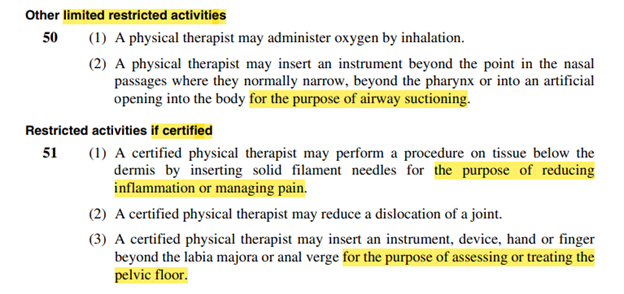
This means a physical therapist may only insert an instrument, device, hand or finger beyond the labia majora or anal verge if 1) they are certified and 2) it is for the purpose of assessing or treating the pelvic floor.
If you have more questions regarding the interpretation of specific restricted activities, please reach out to practicesupport@chcpbc.org.
If you have questions about the process to become certified, please contact certification@chcpbc.org. Please first refer to the profession-specific notice you received; it includes a list of things you can do to prepare. After April 1 you will receive another notice with detailed instructions.
For information about how CHCPBC’s fee schedule was determined, a detailed explanation is in Questions and Answers about the CHCPBC Fee Restructuring Project.
Can I continue to perform a restricted activity that requires certification after April 1 if I’m not certified yet?
If you are eligible for the transition provision to perform a restricted activity requiring certification after April 1, you should apply as soon as practically reasonable. The College is providing a three-month transition period to allow time to process applications and for health professionals to gather the relevant documentation and apply with the intent of avoiding care disruption.
If you are not eligible, do not intend to apply and be certified, you must cease to perform the activity on April 1.